👁️ Welcome to The Beholder's Gazette
Founded in 1492 DR, The Beholder's Gazette is the realm's premier source for satirical news, DM tools, and everything in between. We see all truths — especially the ones we made up.
Our mission is simple: provide Dungeon Masters with high-quality, free tools while keeping everyone entertained. Because let's face it, if the DM isn't having fun, nobody is.
The Gazette is made by Ashforge Studio, a solo TTRPG studio that writes D&D 5e supplements and takes commissions for adventures, lore, and stat blocks.
Satirical News
D&D-themed parody of real-world events
Dynamic Economy
270+ items with fluctuating prices
NPC Generator
Full characters with secrets & quests
Loot Generator
DMG-compliant treasure tables
Spellbook
All 319 SRD spells, searchable
Bestiary
All 334 SRD monsters with full stat blocks
Monster Maker
Homebrew stat blocks with an automatic CR estimate
Rules Quick Reference
Conditions, cover, light, travel, DCs, and lifestyles on one printable page
Handout Maker
Wanted posters, letters, bounty boards, and price lists to print
Tavern Rumors
300+ quest hooks & flavor text
Session Kit
Headline, rumor, NPC, loot & shop on one page
Shop Generator
Shops priced live from the market
DM Screen
Your own screen of cards: rules, dice, initiative, party, clocks, tables, notes, and stat blocks, with a player view and a print
DM Toolbox
Names, taverns, side quests, travel, your party, encounters, dice, your own random tables, initiative (with a player view), progress clocks, loot splits, and downtime
Worldbuilder
Calendars, a pantheon of gods, the factions that run a city, the history behind it, whole towns, family trees, mapped dungeons, a continent map, your own maps to pin, and a web of how it all connects
🛠️ Our Tools
Every tool on this site is designed with one goal: make your D&D sessions better. Here's what we offer:
- Dynamic Economy Tracker: 270+ D&D items with prices that fluctuate every 15 minutes. Perfect for adding realism to your campaign's economy.
- Shop Generator (Merchant's Row): Roll a shop by type and wealth, with a name, a shopkeeper, and stock priced live from the Market Exchange. One haggle roll per shop.
- NPC Generator: Create full NPCs with stats, personality, appearance, dialogue, secrets, and quest hooks. Print them as cards, save them to your grimoire, and print several saved NPCs on one sheet. Need only a name? Roll ten at once.
- Loot Generator: DMG-compliant treasure generation with coins, gems, art objects, and magic items. Export to JSON or copy to clipboard.
- Rules Quick Reference: The rules you look up mid-session on one searchable page: all fifteen conditions, the six levels of exhaustion, cover, light and vision (with how far a torch or lantern reaches), travel pace and forced marches, typical DCs, and lifestyle costs, summed up from the SRD 5.1. Print it as a two-column cheat sheet for behind the screen.
- Handout Maker: Props to hand across the table: wanted posters (with a box to sketch the face), letters and wax-sealed notes, bounty boards of up to six notices, and shop price lists, on parchment or in ink-saving black and white. Type one up yourself, or fill it from a rolled NPC, side quest, or shop (each has a 📜 Make a Handout button) and change whatever you like. Print it or copy the text.
- Spellbook Reference: All 319 spells from the 5th Edition System Reference Document, searchable and filterable by level, school, class, concentration, and ritual. Keep a named spell list per character, print it as spell cards, or share it by link.
- Bestiary: All 334 monsters from the SRD 5.1 with their full stat blocks, filterable by challenge rating, type, size, and habitat. Open any stat block (spells link to their text), copy it, or link to it. Gather monsters on an encounter list, then send it to the DM Toolbox's encounter builder or add it straight to the initiative tracker.
- Monster Maker: Build a homebrew monster, or start from any SRD monster (each Bestiary stat block has a 🐲 button) and tweak it. Size, type, armor, hit dice, speeds, ability scores, saves, skills, damage and condition immunities, senses, and languages, then traits, actions, bonus actions, reactions, and legendary actions, with common ones a click away. Attacks write their own to-hit and damage from the monster's scores, and feature text can use tokens like {dc:wis} that follow them too. The stat block draws itself as you type, beside an automatic challenge rating estimate (defensive and offensive CR from hit points, resistances, Armor Class, damage per round, and attack bonus or save DC) with every step of its working shown, or set the CR yourself. Save it to the campaign notebook, and it shows up in the DM Toolbox's encounter builder and initiative tracker. Copy the stat block, print it, or send a link that carries the whole monster.
- Tavern Rumor Generator: 300+ rumors and quest hooks across 6 categories, with truth values. Perfect for session starters or downtime activities.
- DM Session Kit: The town crier's latest Gazette headline, a tavern rumor, an NPC, a loot roll, and a shop on one screen. Reroll any part, then print the kit or copy it into your notes.
- DM Screen: A screen you build from cards: any rules card, dice with advantage and disadvantage, the initiative order, your party's AC, HP, and passive Perception, progress clocks, your own random tables, notebook entries (session recaps, quests, NPCs), SRD or homebrew stat blocks, and notes. Drag the cards into place, make them wide or tall, and keep a named layout per campaign or per fight. Mark the cards the players may see and open them in a second window for a TV (it follows along, and never shows stat blocks, HP, or DM-only notes), or print the whole screen in ink.
- DM Toolbox: Quick table tools. Roll ten tavern, inn, or shop names at once and keep the ones you like, or roll a whole tavern: its owner and regulars, a menu and rooms priced by SRD lifestyle, a quirk, tonight's goings-on, and a rumor from the bar, ready to copy or print. Roll a side quest for the party's level: who's asking and why, the job and where it happens, a deadline, a twist, a reward that grows with the party, and sometimes an SRD foe to send straight to the encounter builder; save it to the campaign notebook to track it. Take a journey one day at a time: weather by climate and season, a road event, and the day's distance by SRD travel pace, with forced marches and gallops worked out. Build a fight from the SRD monsters, or roll one, open any monster's full stat block (spells included), and see whether it's Low, Moderate, or High for your party before sending it to initiative. Roll any dice formula (
2d6+3,4d6kh3) with advantage or disadvantage and a roll history, write your own random tables (paste a list or a table with die ranges; an entry can roll another of your tables or roll dice, and a link shares a table with the tables it rolls), run combat with an initiative tracker for HP and conditions that survives a refresh (with a 📺 player view for a TV or second screen that shows the turn order, conditions, and health as Healthy, Bloodied, or Down, and keeps monster names hidden until you reveal them), track looming threats on progress clocks of 4, 6, 8, or 12 segments, and split the party's coins evenly in gold, silver, and copper (the Loot and Session Kit pages send their treasure straight to it). Between adventures, the downtime tracker prices each character's lifestyle by the week and works out crafting progress, working for pay, research, recuperation, and (by house rule) carousing. Enter your party once (name, class, level, AC, HP, passive Perception) and the encounter builder, side quests, coin splits, downtime, and the Worldbuilder's dungeons start from it, while initiative adds the whole party with one button. A floating 🎲 button on every tool page rolls dice without leaving the page. - Worldbuilder: Tools for the world around the table. Roll a calendar: the reckoning and this year's name, months and weekdays in one of seven naming styles, seasons that suit the climate, one to three moons with their phases and the nights they're full together, and a festival every month with what happens, what the party can do there (with the checks to do it), what's on the table, and what could go wrong. Browse it a month at a time. Then roll a pantheon: four to thirteen gods as a family, a heavenly court, two camps, or many peoples' gods, each with what they rule, a cleric domain and alignment, a holy symbol, a holy day, what the faithful must and mustn't do, the temple and its priests, an omen, and a job for the party, plus the feuds and friendships between them. Put the holy days on the calendar to see their dates. Then roll the factions of a town, a city, or a kingdom: three to nine guilds, cults, noble houses, thieves' rings, knightly orders, temples, mages' circles, and mercenary companies, each with a goal and a method, what it's doing right now, a leader and lieutenants (each opens in full on the NPC page), a base, a symbol and motto, members and a treasury, resources, a secret, a job for the party, and its rivals and allies. Temples and orders can follow the pantheon's gods. Then roll the history: four to twelve ages over centuries or tens of thousands of years, each following from the one before (a war ends in a fall, a treaty, or a plague; a fall brings a dark age, an invasion, or a new crown), with realms rising and falling, who mattered, the faith of the day, and the ruins, grudges, relics, and customs each age left behind, with a hook for today. Link the pantheon and the factions, and the ages name those gods and show when each faction was founded. Then roll a town, from a hamlet to a metropolis: its name and what it's known for, its folk, how and when it was founded, who runs it and how, the watch, the temple and its god, its districts and how many of each building there are, the people worth knowing and how they're tied to each other, the factions in town, its taverns and shops (each one opens in the Toolbox or on the Shop page), local laws and customs, the trouble right now, a few rumors, and a job for the party. Then roll a family tree: a noble house, or the family of any faction leader or noble town ruler, with parents and grandparents, brothers, sisters, and cousins, children and grandchildren, the partners who married in, the dead and what took them, and a secret or two. Everyone old enough opens on the NPC page as the same person, and you can change anyone, add or remove people, or start a family by hand and keep it in the notebook. Then roll a site to explore: a crypt, a lost mine, a wizard's tower, a sunken temple, a bandit fort, a monster lair, or a ruined keep, with a map of five to twelve rooms and a key to each one: a feature, the foes who hold the place (sized to your party, and every fight opens in the Toolbox), traps, doors and secret doors, wandering monsters, and a hoard at the end that opens in the Loot generator. Download its map as a battle map on a 5-foot grid for Owlbear Rodeo, Foundry, Roll20, or any virtual tabletop, with or without the grid, the room numbers, and the secret doors. Link the history and the site is dated to one of its ages. Then roll a continent: a map with coasts and islands, mountains, rivers that run to the sea, forests, deserts, and swamps, and climate bands from north to south, with three to eight nations on it, each with its government, a ruler (who opens on the NPC page), its towns, its exports, a banner, and a feud with a neighbor, plus the roads between the towns and the ruins, lairs, and towers worth the trip. Every town opens on the Town tab inside its realm, every place on the Sites tab, and every road, or any journey between two towns, in the Toolbox's Travel tab with its terrain and miles filled in. Drop your own numbered pins on the map, name them, and link each to a notebook entry (a town, a site, a faction) that the pin then opens; they're kept with the map in your notebook. Download the map as a picture to share, with or without your pins. Or bring your own: upload a map from Inkarnate, Dungeondraft, or a scan of one you drew, pan and zoom around it, and pin it the same way; your maps stay in your browser. Copy, print, or share any of them, and save the ones you keep to the campaign notebook, which also keeps a session log (what happened, the NPCs met, the loot, the open threads), tracks quests as open, done, or failed, and reads back "last time on…" to start the next game. Keep secret notes beside the ones the players may see, and print chosen entries as parchment handouts with every secret left out. Then see the whole campaign as a web: every entry in the notebook, with a line wherever two of them meet (a link, a map pin that opens one, a family member who is a saved NPC). Hover any entry to light up what it's tied to, drag entries where you want them, filter by kind, and download the web as a picture.
- Satirical News: D&D-themed parody articles that mock real-world politics, economics, and current events.
- Across the Multiverse: Real news from the tabletop RPG hobby: new books and games, the industry, actual play, conventions, and crowdfunding. No satire on this desk.
👥 The Team
Behind every great publication is a team of dedicated (and slightly unhinged) individuals.
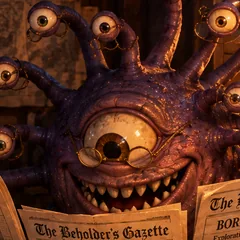
The Beholder
Editor-in-Chief
Sees all truths. Especially the convenient ones.
Gimble Inkquill
Lead Scribe
Writes the news. Sometimes makes it up.
Gobwiz Quillnib
Investigative Bard
Specializes in political scandals and zoning violations.
You
Valued Reader
Without you, we're just shouting into the void.
❓ FAQ
Is this site free?
Yes! All tools are completely free. We accept voluntary donations via Patreon to keep the servers running and the bards fed.
Can I use this for my campaign?
Absolutely! That's what it's for. Generate NPCs, loot, rumors, and spell lookups to your heart's content.
Is the economy tracker accurate?
Base prices follow the standard 5e price lists. Every 15 minutes they drift by up to 15%, and every visitor sees the same board, so your whole table can shop from the same numbers. Use it as a guide, not gospel.
Can I contribute rumors or articles?
Currently, contributions are session-only. We're working on a submission system for the future!
Why is everything satire?
Because D&D is supposed to be fun. If we can make you laugh while you prepare your session, we've done our job. The one exception is Across the Multiverse, our desk for real tabletop RPG news, which runs straight and under real names.
📜 Credits & Licenses
This work includes material taken from the System Reference Document 5.1 ("SRD 5.1") by Wizards of the Coast LLC, available at dnd.wizards.com/resources/systems-reference-document. The SRD 5.1 is licensed under the Creative Commons Attribution 4.0 International License.
The DM Toolbox's encounter difficulty also uses the XP Budget per Character table from the System Reference Document 5.2 ("SRD 5.2") by Wizards of the Coast LLC, available at dnd.wizards.com/resources/systems-reference-document. The SRD 5.2 is licensed under the Creative Commons Attribution 4.0 International License.
That covers the rules summed up on the Rules Quick Reference page and the DM Screen's rules cards, the spell text in the Spellbook, the magic item text in the Vault of Wonders and the DM Session Kit, and the travel pace rules, tavern food, drink, and lodging prices, lifestyle costs and downtime activities, condition names, coin values, and monster stat blocks in the Bestiary, the Monster Maker, the DM Screen, and the DM Toolbox, and the ability checks at the Worldbuilder's festivals, the cleric domain names in its pantheons, and the trap DCs and damage in its dungeons. Magic items outside the SRD are listed by name only.
The Beholder's Gazette is unofficial fan content. It is not approved, endorsed, or affiliated with Wizards of the Coast.
📬 Contact Us
Have questions, suggestions, or want to report a bug? We'd love to hear from you!
Messages are delivered privately through Google Forms. See our privacy page.